Serket: scorpion and waterscorpion in Ancient Egypt.
The goddess Serket was associated in Ancient Egypt to the scorpion and to the waterscorpion.
Scholars have usually cosidered the ancient Egyptian goddess Serket as a goddess scorpion, whose harmful bite made her an effective protection against poisonous stings. Not for nothing, Serket is invoked in many remedies against scorpions bites.
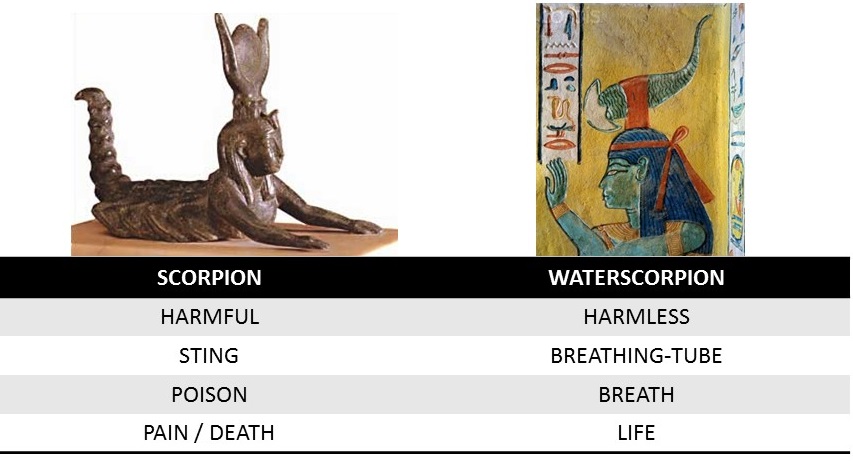
But the animal in the head of this ancient Egyptian goddess when she is depicted as a woman, although similar to a scorpion, seems to be a nepid, that is a water scorpion, which is a harmless insect that lives in the marshes.
It makes sense to think that in the belief of Ancient Egypt the scorpion and the waterscorpion were two faces of the same goddess…
As we have seen in a previous post, the iconography of this coffin contains traditional images of Egyptian art to guarantee the resurrection of the deceased. In addition, in the previous post we exposed that the decoration was perfectly distributed on the surface....
Images in Egyptian art were much more than just designs, specially in funerary sphere. They were a tool for achieving a goal and their effectiveness was out of doubt. Moreover, the artist also had to choose their location on the surface for creating a coherent...
Clay Coffin of Men. Dynasty XVIII. Tell el-Yahoudiyeh (tomb 411). Musées Royaux d'Art et d'Histoire de Bruxelles, E.4348. Photo: MRAH Coffins in Ancient Egypt were not made just in wood, but also in ceramic. Although these kind of coffins are much more common in...
Thanks to the numerous documents that has come down to us from Ancient Egypt, almost all related to their religious beliefs, we know about their gods, the ceremonies they practiced, their mythologies, and above all how they buried their dead and also how they did...