ETERNAL AKHENATEN
The influence of Amarna Art in the Rameside Period
Would you like to receive the PDF? Just write me!
It is usualy assumed that Akhenaten’s death marked the end of the Amarna period. The new capital was abandoned, the royal family’s mummies were transferred and hidden in Thebes, the traditional religion was restored, and the artistic style of that era ceased to be used.
However, we can see how in some later works the artistic production of Amarna left a permanent mark on Egyptian artists and scribes.
A clear example is the stele of the soldier Mose, one of the fifty-four small Ramesside stelae known as the Horbeit stelae (they were discovered at Horbeit, near ancient Pi-Ramesses). These were private votive monuments depicting individuals before statues of the deified Ramesses II.
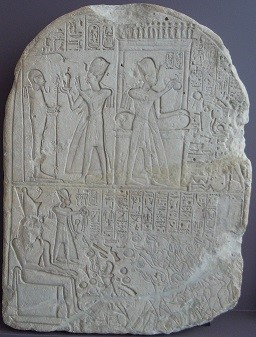
Stele of the Soldier Mose. Ramesside Period. Roemer- und Pelizaeus-Museum Hildesheim. Image: Wikimedia
The Stele of the Soldier Mose
The stele of the soldier Mose represents the moment in which Ramesses II rewards Mose with the “gold of reward” (or “gold of honor”), an official recognition for services rendered to Egypt. It is the largest and most exceptional stela of the group because of its decoration.
When each scene is carefully examined, many elements, which connect with the Amarna period, showing this influence of Amarna art in the Ramesside period, more than a century after Akhenaten’s reign.
Upper Register
The upper register presents two clearly differentiated scenes. On the left, Ramesses II makes an offering directly to the Memphite god Ptah in a divine setting. On the right, the pharaoh, leaning from an architectural structure and resting his arm upon a soft cushion, presents Mose with the gold of reward. Although the monument is damaged, Mose can still be discerned with raised arms receiving jewels and gifts.
Key elements in the upper register
- On the far left, god and pharaoh are represented at the same scale, indicating same hierarchy, and stand upon the same ground line. These features indicate that both belong to the same dimension.
- On the right, Ramesses II appears leaning out from the opening of a building.
- On the far right, the soldier Mose is depicted on a smaller scale and at a lower level, indicating his inferior status and his belonging to another dimension.
Lower Register
The lower register also contains two differentiated scenes. On the left, divine presence is represented through the seated statue of the deified Ramesses II. Above Ramesses the god stands Ramesses the pharaoh, represented on a smaller scale but still occupying the same physical space as his divine image. The king throws the gold of reward toward Mose, who catches the gifts falling from above.
The relief on the lower right is remarkable for its dynamism and spontaneity. It depicts a crowded and somewhat chaotic group of soldiers, probably fellows of Mose, excitedly trying to receive part of the reward. One can easily imagine common soldiers pressing together in an attempt to seize whatever objects fell to the ground or whatever the pharaoh decided to throw to them.
Key elements in the lower register
- The images of Ramesses, both god and pharaoh, occupy the same space and therefore belong to the same sphere. The smaller image of Ramesses the pharaoh above his divine form appears almost as a manifestation of it.
- As in the upper register, Mose and the soldiers receive the rewards from a lower level.
- The group of soldiers appears animated and disorderly, introducing a sense of spontaneity unusual in more traditional Egyptian compositions.
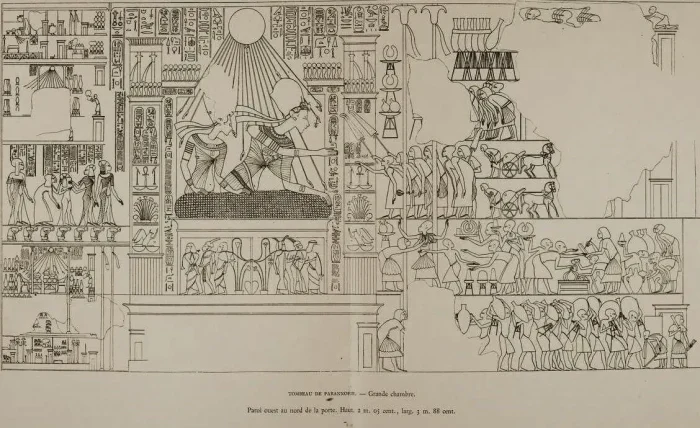
Without doubt, this relief of the stele of Mose evokes the well-known image of Akhenaten distributing the gold of reward from the “Window of Appearances,” an opening in the facade of palaces and temples through which Akhenaten, Nefertiti and sometimes also their daughters appeared before their subjects. This motif was introduced into Egyptian art during Akhenaten’s reign and was represented in several private tombs at Amarna.
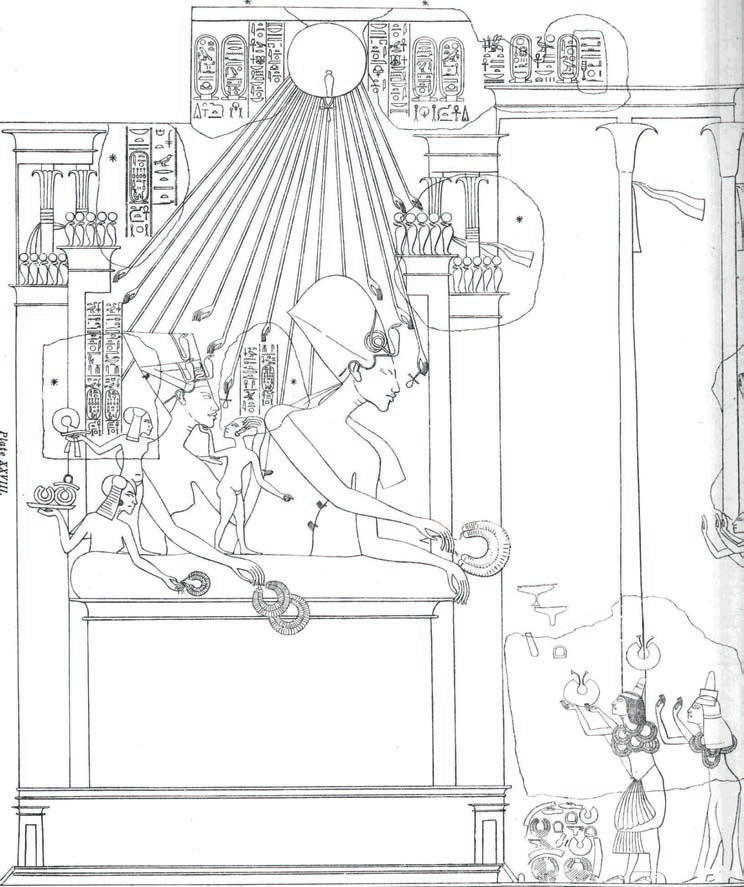
Akhenaten and his family giving the gold of honour to Ay (Tomb EA25).(Davies, 1908, vol. 6, pl. XXIX)
Tired of reading on a screen? Write to me to receive the PDF.
Differences in the Stela of Mose
Naturally, the iconography of Mose’s stela differs in several ways from the Amarna prototypes:
- Ramesses II appears alone, not accompanied by wife and children as Akhenaten often was.
- The pharaoh leans from a window closed at the upper frame, lacking the solar disk and rays that were essential during Akhenaten’s reign.
- Ramesses II is standing rather than emerging naturally from within the window, resulting in a less spontaneous gesture than those seen in Akhenaten’s.
Similarities in the Stele of Mose
Despite these differences, there also similarities that demonstrate the influence of Amarna art in the Ramesside period.
Stylistic similarities
- Ramesses II personally delivers the gold while resting his arm upon a soft cushion, exactly as Akhenaten did. This natural gesture clearly remained within the artistic repertoire of Egyptian workshops.
- Mose, as a lower-status figure, is represented on a smaller scale and receives the gifts from below. In Amarna art, the height from which Akhenaten rewarded officials emphasized the hierarchy between royalty and subjects.
- Behind Mose, the agitated crowd of soldiers introduces movement, spontaneity, and disorder, something typical of the common folk. The dynamism and to sideline low-ranking people in the composition could also be a way to indicate the low status. This is another characteristic feature inherited from Amarna art, as we could see in our previous post about this scene in the tomb of Ay (EA25).
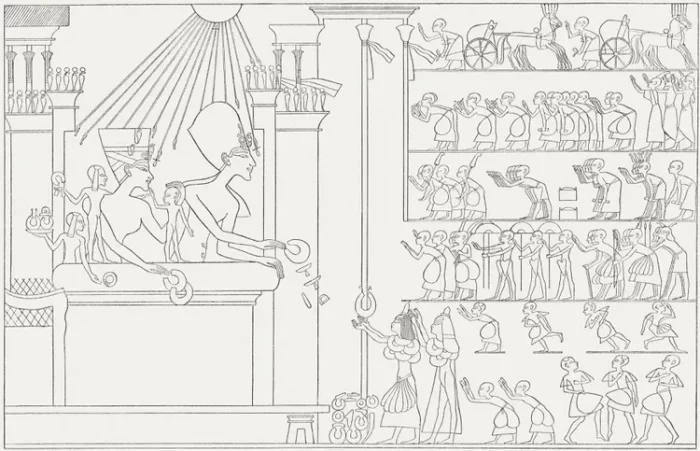
Akhenaten and his family giving the gold of honour to Ay, meanwhile, at the right corner, a group of common people celebrates the moment. (Tomb EA25).
Conceptual Similarities
Not less important are the conceptual parallels, which, joint with the iconography, confer greater spirituality to the piece.
The Arrangement of the Images
Akhenaten did not create the scene of distributing the gold of honor from the Window of Appearances out of whim. The scene was designed to express, with an official act, very concrete ideas.
 From the heavens, the solar disk (the Aten), projected its divine light in the shape of rays ending in hands that holding the symbols of life and power, and addressing them directly to Akhenaten’s nostrils. The pharaoh therefore received vital force from the hands of the sun god.
The subject below then received directly from the pharaoh’s hands the gold, the supreme solar symbol. Through this act, the individual was “solarized” and revitalized, because in the spirituality of Amarna, the Aten was the source of all life, as expressed in the Hymn to the Aten:
“Your brightness makes live hearts… humans, cattle, and all animals live when you shine for them“.
The course of this vitality or solarization was therefore clear. The sun god gave them to Akhenaten and the Pharaoh to the subject. Because the breath of life was a royal monopoly and people could only access to divinity through the king in the Window of Appearances. It was a vertical trajectory in this order:
Solar Disk (Aten) → Akhenaten → Subjects
Although the Window of Appearances lost much of its theological meaning during the Ramesside age, the same symbolic structure survives in the stele of Mose.
Ramesses II is shown in direct contact with divinity through his offering to Ptah (upper register) and through his association with his own deified seated statue (lower register), and in both cases occupying the same physical space. It is the divine sphere.
Mose and the soldiers, on earth, receive the gold from the pharaoh’s hand, who comes from divine sphere, because has already interacted with the divine realm and arises from his own deified image.
The symbolic circuit remains identical:
Divinity → Ramesses II → Mose and the soldiers
 The Solar Message of the Texts
Apart from this “established order”, the inscriptions themselves also preserve traces of Amarna solar symbolism.
On one hand, in the lower register (whose text is better preserved), the pharaoh is identified as “Ramesses, the Sun of the rulers”. This epithet clearly preserves a solar conception of kingship.
On the other hand, the inscription upon the soldiers show how they shout to the pharaoh as they catch the gifts thrown to them:
“You are Re! You are like Atum! You shine. We live when we see you.”
The paralelism in these acclamations with the Hymn to the Aten, where the solar disk and its brightness is mentioned as the source of life, is impossible to ignore.
Thanks for reading! If you want the PDF, just ask me!
Conclusion
The stele of the soldier Mose provides remarkable evidence for the influence of Amarna art in the Ramesside period.
Akhenaten died and Atenism had officially disappeared, but elements of its imagery and ideology remained in the Egyptian corpus of images and texts. So, more than a century after Akhenaten’s death, some artists and scribes still used them, although we do not know if they were conscious of its meaning.