The Royal Prince Tutankhuaton. An Innovation in the Art of Amarna
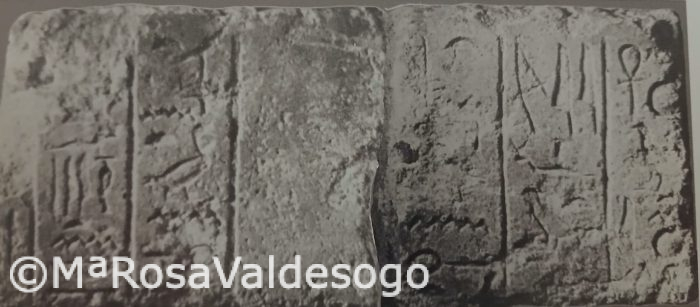
A block from Ashmunein showing Tutankhuaton as royal prince, an innovation in the art of Amarna.


A block from Ashmunein showing Tutankhuaton as royal prince, an innovation in the art of Amarna.
The both sides of the mummy was a good place for strategical iconography. At first sight, it seems that the Egyptian artist did not spend many sources in the decoration at right and left of Artemidora. It is about a very minimalist image consisting just in three...
Isis and Nephthys are the most preeminent figures on the decoration over the mummy of Artemidora. Over the wrappings of the feet, two appliqués of gold depicted these two goddesses Isis and Nephthys on the feet of the mummy of Artemidora. Photo: www.metmuseum.org...
Looking carefully at the decoration on the mummy of Artemidora we can discover the intentions of the artist.
To understand the figure of the Egyptian artist it is convenient to differentiate art and craft in ancient Egyptian art. Ancient Egyptians just had the word hemuu (Hmww), for referring to the workers who carried out a work. In addition, those ones could be...
The idea of duality referred to good and evil confronted and linked. And it also meant two halves, which formed a unity. Duality is Egypt. Egypt itself evoked also that idea of duality, because the country was formed by two parts: Upper Egypt and Lower Egypt. For...

In the ideological thinking of Ancient Egypt, duality played a crucial role. The equilibrium principle could not exist without the imbalance; and in front of the idea of order was that of disorder. Duality in Egyptian landscape. Duality was supported by the...
The uniformity of Egyptian Art had also political basis. Pharaoh and Uniformity in Egyptian Art. In the state sphere, the Egyptian society required a balance, which depended directly on Pharaoh. The Egyptian monarchy was an institution with double nature, divine...
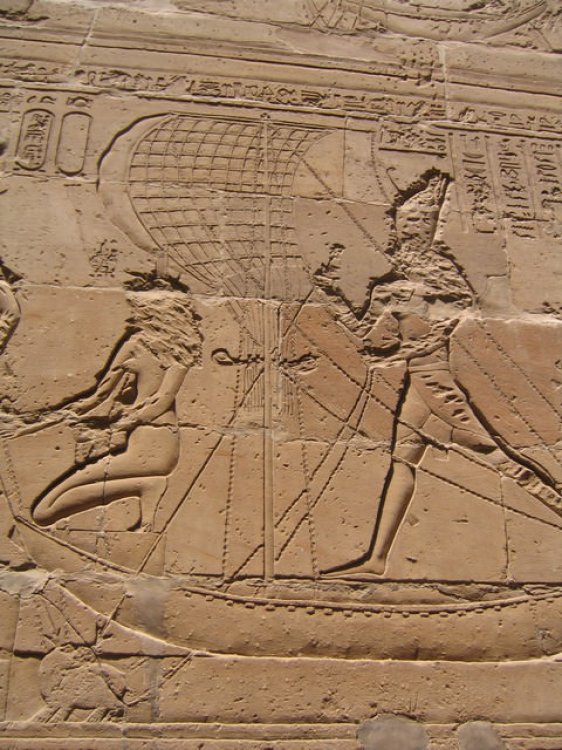
At a celestial level, the cycles of the moon and the sun also had a strong influence in Egyptian Art. This influencie was in uniformity and also in iconography. The Uniformity of the Moon and the Sun. The lunar phases: quarter waning, new moon, crescent quarter and...
Plastic manifestations in Egyptian art remain almost unchanged for more than three millennia. Why? Art is something intimately linked with human feeling, with its conception of the world and with its ideology. But Egyptian art is the product of a collective...
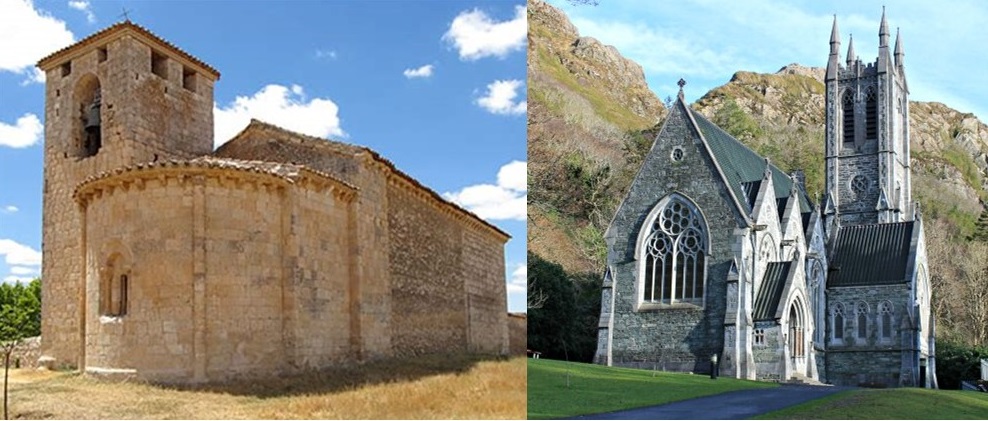
Egyptian art shows an apparent uniformity, which makes us to refer to a unique Egyptian style. However, if we pay attention to other cultures of antiquity this perception is different. Evolution in European Art Greek art, for example, goes through different stages...
Artists and theologist of Ancient Egypt worked together in the emergence of iconographies and they combined different planes of meaning: images and words. That is why reading the Egyptian art requires an iconographic and textual analysis. The Egyptian...
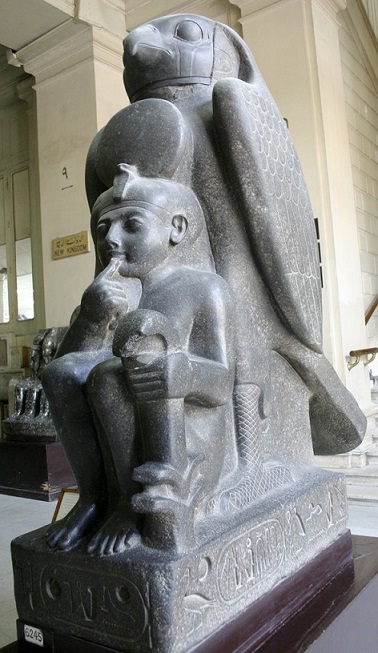
Egyptian art had a magical-functional purpose and did not take into consideration the figure of the spectator. For that reason, we cannot consider Egyptian art from just an aesthetic empiricism. Which makes art feel in a subjective way through sensations. We must...